





Little noticed in the Republican effort to pass President Donald Trump’s sweeping tax and spending plan this summer was the accomplishment of a long-held party goal: rolling back significant portions of the Affordable Care Act.
But now, the battle over Obamacare is back. Democrats are demanding that at least some of the cuts to former president Barack Obama’s signature law be reversed in exchange for their support of a funding bill, while Republicans are daring Democrats to risk shutting down the government over the issue.
Looming above it all is growing nervousness among some Republicans about the political consequences of millions of people losing health insurance as soon as January – and in the months ahead of next year’s midterm elections.
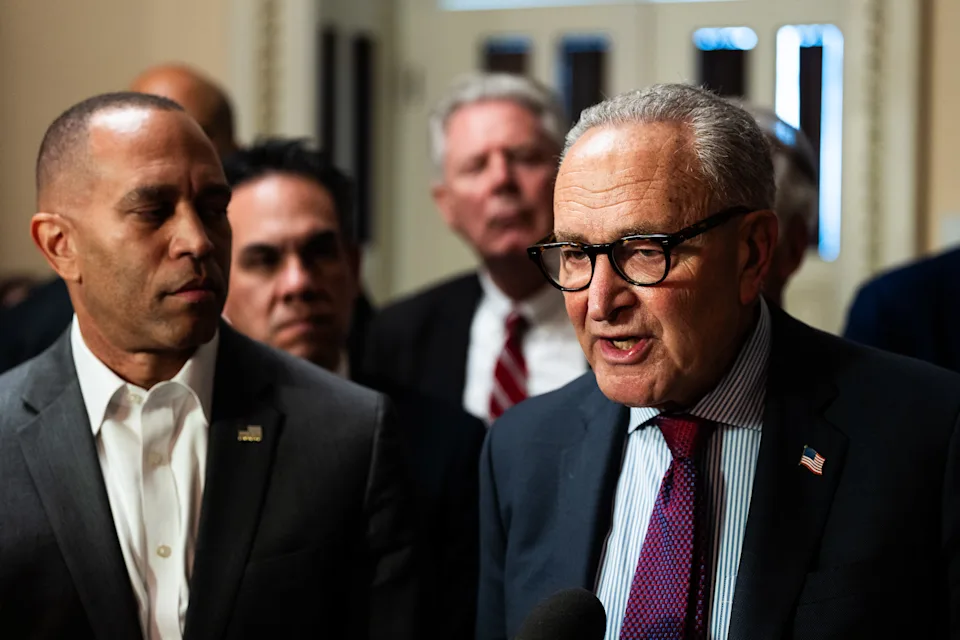
“The House Republican-only spending bill fails to meet the needs of the American people and does nothing to stop the looming health care crisis,” Senate Minority Leader Charles E. Schumer (D-New York) and House Minority Leader Hakeem Jeffries (D-New York) said in a joint statement Tuesday.
“At a time when families are already being squeezed by higher costs, Republicans refuse to stop Americans from facing double-digit hikes in their health insurance premiums,” Schumer and Jeffries said.
Voters across the country are already beginning to feel the impact of the recent ACA rollbacks. They could also see their premiums rise when enhanced tax subsidies to purchase ACA marketplace insurance plans – which Democrats passed under President Joe Biden – expire at the end of the year. Insurers have already started sending notices to consumers that their premiums will rise significantly in 2026.
Without the enhanced tax credits in place, ACA marketplace consumers’ out-of-pocket premium payments will rise by more than 75 percent on average, according to an analysis from KFF, a health policy research organization. A separate KFF analysis found that insurers’ median proposed increase for 2026 is 18 percent – more than double last year’s 7 percent median proposed increase. About 4 million people are expected to lose insurance over the next decade if Congress does not extend the subsidies, according to the nonpartisan Congressional Budget Office.
House Speaker Mike Johnson (R-Louisiana) and Senate Majority Leader John Thune (R-South Dakota) acknowledged that some of their members are worried about the subsidies expiring but said that Congress had until the end of the year to address the issue, indicating that they were willing to work on a separate bipartisan solution once Congress passes a government funding bill. Schumer has demanded Republicans make health care concessions, such as extending the enhanced subsidies, part of any government funding bill.
“I can tell you that there’s a real concern. I have concern. Republicans have concern about those policies,” Johnson told reporters Tuesday. “There’s a relatively small number of people that are affected by it, but that policy has real problems, and subsidizing that and making it a finance issue instead of health care issue is a problem, so we have time to have that debate.”
There are other early impacts from Trump’s One Big Beautiful Bill, which Republicans passed in July, that Democrats have seized upon on the campaign trail. Several hospitals have already announced they will cease providing certain services or close altogether because of the Medicaid cuts in the bill – an issue several Republicans raised during negotiations this summer.
The law extended tax cuts from Trump’s first term that were set to expire and added hundreds of billions of dollars in funding for immigration enforcement and national defense. To offset some of those costs, the bill cut nearly $1 trillion in Medicaid spending over a decade, largely targeting the program’s expansion under the ACA.
The cumulative effect of the health care measures in the bill – and the expiration of the enhanced tax credits – is that more than half of the insurance gains made under the ACA will be wiped out, said Larry Levitt, executive vice president for health policy at KFF. More than 20 million people gained insurance under the Obama law, and record numbers signed up for ACA marketplace plans in the past five years with the enhanced subsidies in place.
“The Republican tax and spending law was not framed as a partial repeal of the ACA. It wasn’t even framed as a health care reform effort,” Levitt said. “The effect, in terms of loss of health coverage, would be comparable to the earlier effort to repeal and replace the ACA.”
The biggest health coverage losses come from imposing federal work requirements for adults between 19 and 64 years old. Those requirements are targeted only at the Obamacare Medicaid expansion population, which includes those earning up to 138 percent of the federal poverty level. There are exemptions for certain groups, including pregnant women, disabled people and caregivers of children under 13.
Republicans have been attempting to curtail or undermine the ACA for years, including a 2017 attempt to repeal the law in its entirety. But the sweeping health care changes Republicans passed this summer were tucked inside a behemoth bill, helping the GOP avoid much of the drama that plagued its earlier repeal effort.
There are distinct differences between the 2017 repeal effort and the bill that passed this summer. The new law keeps core tenets of the ACA intact, including mandating that health insurers cover those with preexisting conditions, allowing children to stay on their parents’ plans until age 26, and requiring that certain businesses provide health insurance – all among the most popular provisions of the law.
But it also takes steps to penalize the 40 states and the District of Columbia that adopted the Medicaid expansion. The 10 states that have not taken the expansion are almost all led by Republicans, including Florida, Texas, Georgia and South Carolina.
For instance, one provision of the law most opposed by hospital groups applies only to expansion states. That is the reduction in the provider tax, which states collect from hospitals to boost Medicaid payments and receive higher matching funds from the federal government, as well as another mechanism called state-directed payments.
Trump’s budget bill is one of the most unpopular pieces of legislation passed by Congress in recent years, with nearly two-thirds of Americans holding unfavorable views of the legislation, according to a KFF poll conducted in July shortly after the president signed the bill into law.
Republicans have been struggling to sell the bill to a wary public – prompting key White House officials to meet with GOP members last month to urge them to overhaul their messaging – and Democrats plan to make it a central part of their effort to retake the House in next year’s elections. Trump has not traveled across the country to sell the bill to voters.
“Democrats are united in lowering the cost of health care for all Americans. When voters go to the polls next year, they’ll remember which party caused their premiums to increase, and it will cost Republicans their House Majority,” Courtney Rice, communications director for the Democratic Congressional Campaign Committee, said in a statement.
Republican states rely most heavily on the tax credits – especially those that did not take the Medicaid expansion. Texas, Florida and Georgia alone, for instance, accounted for more than 40 percent of enrollees on Obamacare marketplace plans at the end of 2024, according to Capstone, a global strategy firm. More than 65 percent of enrollees are in Republican-led states.
Tony Fabrizio, Trump’s pollster during the 2024 campaign, published a memo in July that said Republicans could overcome a deficit with voters by extending the subsidies. The memo stated that a generic Republican was down 7 percentage points against a generic Democrat among those most motivated to vote. That deficit would grow to 15 points if the subsidies expire, Fabrizio wrote, noting that voters on the individual marketplace voted for Trump by 4 points.
If Republicans extend the tax credits, the memo stated, then a generic Republican would lead by 4 points among those most motivated to vote. “The incentive is to act on extending the tax credit soon,” Fabrizio wrote.
The center-left think tank Third Way published a memo last week urging Democrats to “refuse to participate in a bipartisan effort to fund the government unless the GOP solves the health care cost crisis they alone caused.” The memo argues that Democrats should demand that Republicans permanently extend the enhanced subsidies and reverse cuts to Medicaid.
“This is the rare shutdown fight in which the policy, politics, and leverage all align,” the memo stated. It added: “While there are many targets and outrages, Democrats must train fire on the ones most pertinent to Americans and most sensitive to swing-state and swing-district Republicans. That battleground is clear: health care costs.”
– – –
Mariana Alfaro contributed to this report.