





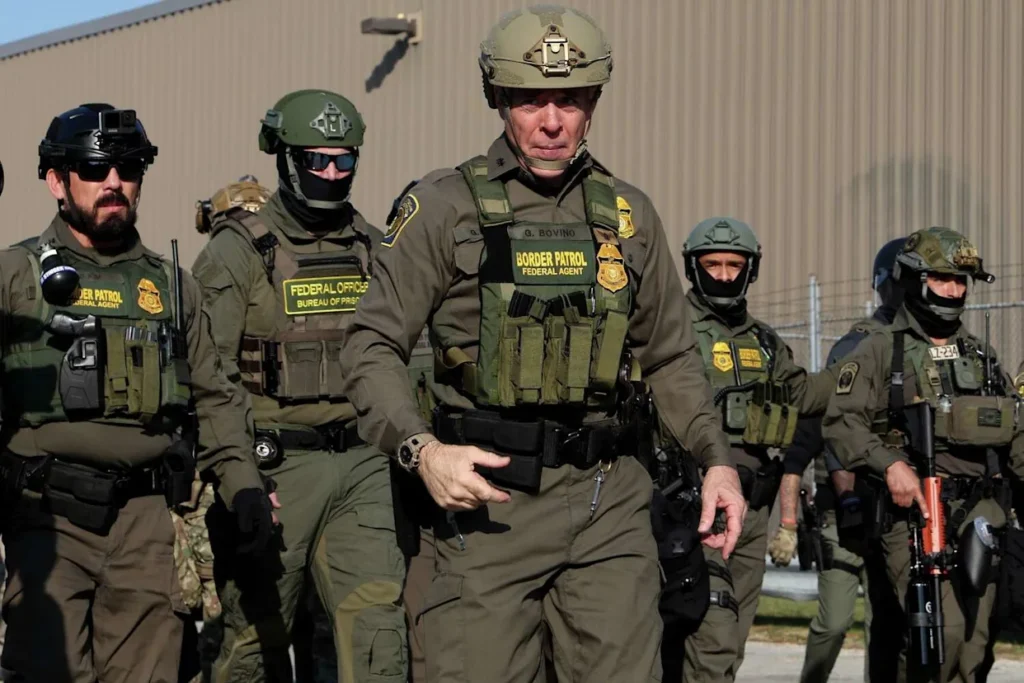
The Trump administration on Wednesday dispatched more than 100 federal agents, including from U.S. Customs and Border Protection, to a U.S. Coast Guard base in the East Bay, marking the beginning of a long-threatened immigration crackdown on the region.
The Coast Guard and a source familiar with the operation confirmed the surge of federal agents, who are expected to begin arriving Thursday. The decision was seen as a likely precursor to President Donald Trump deploying National Guard troops to San Francisco, mirroring similar immigration operations in other cities around the nation.
The crackdowns have alarmed undocumented immigrants and those close to them. In previous immigration actions, the federal government has said it was targeting the “worst of the worst,” though many others swept up in the operations have no criminal convictions.
Trump has repeatedly threatened to deploy troops to San Francisco in recent weeks, telling Fox News on Sunday: “We’re going to San Francisco and we’ll make it great. It’ll be great again.” His incursion into the region sets the stage for a showdown with local leaders, who have said San Francisco does not need his help to quell chaos on the streets and vowed to sue to block any National Guard deployment.
San Francisco Mayor Daniel Lurie condemned the impending federal action in his most forceful comments yet.
“In cities across the country, masked immigration officials are deployed to use aggressive enforcement tactics that instill fear so people don’t feel safe going about their daily life,” Lurie said at a live-streamed press conference, flanked by local politicians and law enforcement leaders. “These tactics are designed to incite backlash, chaos and violence, which are then used as an excuse to deploy military personnel. They are intentionally creating a dangerous situation in the name of public safety.”
Lurie and Gov. Gavin Newsom urged people not to be baited into violence.
“President Trump and Stephen Miller’s authoritarian playbook is coming for another of our cities, and violence and vandalism are exactly what they’re looking for to invoke chaos,” Newsom wrote in a social media post. “Help keep yourself and your communities safe. Remain peaceful.”
The Chronicle first reported on CBP sending the agents to the Bay Area, based on a source who spoke on the condition of anonymity because they were not authorized to speak to the media. A Coast Guard spokesperson later confirmed it was preparing to use its Alameda base, in the estuary between Oakland and Alameda, as a “place of operations” for CBP agents.
The Coast Guard is part of the Department of Homeland Security, which oversees CBP.
{ “__type”: “devHubFreeformEmbed”, “__id”: “Datawrapper”, “__fallbackImage”: “https://datawrapper.dwcdn.net/hDQ5g/mobile.png”, “__data”: { “datawrapper_id”: “hDQ5g” } }
“This support of DHS agencies continues the Coast Guard’s operations to control, secure, and defend U.S. borders and maritime approaches,” the spokesperson wrote in a statement. “Through a whole of government approach, we are leveraging our unique authorities and capabilities to detect, deter, and interdict illegal aliens, narco-terrorists, and individuals intent on terrorism or other hostile activity before they reach our border.”
Asked to confirm the operation and its goals, DHS officials said in an emailed statement that the department was “targeting the worst of the worst criminal illegal aliens-including murderers, rapists, gang members, pedophiles, and terrorists – in cities such as Portland, Chicago, Memphis and San Francisco. As it does every day, DHS law enforcement will enforce the laws of our nation.”
Trump has said he might invoke the Insurrection Act, a law that allows presidents to deploy troops on U.S. soil. He has already sent National Guard members to Los Angeles; Memphis, Tenn.; Chicago; Washington, D.C.; and Portland, Ore. The Chicago deployment is on hold in a case before the U.S. Supreme Court.
About 300 California National Guard troops remain federalized under an order from Trump that has been extended through February 2026, meaning the president already has the power to move those troops into San Francisco. About 200 of them have been sitting in limbo in Oregon, as a court battle over their deployment plays out. The rest are in Los Angeles, where they were initially sent in June.
At least 80 asylum seekers have been arrested in San Francisco courthouses since May, with the last arrest having happened on Oct. 3, said Milli Atkinson, an attorney who heads San Francisco’s Rapid Response Network providing legal assistance to detained immigrants.
Atkinson said there were rumors swirling everywhere about a potential immigration raid. Atkinson said she and other attorneys were encouraging people to call their local rapid response hotline if they witness any immigration enforcement activity, follow their local network on social media for updates on confirmed activity and review “know your rights” information available on the rapid response network’s website.
Portions of California have different restrictions in place guiding how aggressive federal immigration agents can be in their efforts to arrest and deport immigrants without legal status.
In the federal court district that covers Sacramento and Kern counties and eastern portions of the state, a judge approved an injunction aimed at preventing agents from racially profiling residents by targeting them based on their appearance or what language they’re speaking. It was approved after a January raid in which agents targeted farmworkers.
The order prohibits Border Patrol agents from stopping people without reasonable suspicion that they are noncitizens in the U.S. and are in violation of federal immigration law. It also bars them from arresting people without a warrant if agents don’t have probable cause to believe the person is likely to flee.
The New York Times reported earlier this month that the U.S. attorney in the Eastern District of California was swiftly fired after she told Gregory Bovino, the Border Patrol chief in charge of the raids, that he was required to follow the order.
A similar order was approved in the district covering Los Angeles and other portions of Southern California, where Border Patrol and ICE agents have conducted raids in public places. But the Supreme Court overturned that order. In doing so, Justice Brett Kavanaugh, who was appointed by Trump, said that stops in which U.S. citizens were targeted based on their appearance were both rare and harmless.
Such stops would be “brief” and once officers saw proper documentation of citizenship, residents would “promptly be let go,” he wrote. That has not occurred in practice: ProPublica reported that at least 170 American citizens have been held against their will by immigration agents since Trump took office in January, and in some cases have been beaten, shot, detained while pregnant and denied access to lawyers and loved ones.
Shilpi Agarwal, the legal director at the ACLU of Northern California, said her organization is assessing its legal options in the Bay Area. She said they will monitor whether Border Patrol agents engage in racial profiling or some of the other tactics that the ACLU has challenged in other parts of the state.
“What we have seen in other jurisdictions is that CBP has been stopping people and arresting them and employing the machinery of immigration detention fairly indiscriminately based on whether they look Latino or where they’re standing,” she said. “That is certainly what we’re going to be on the lookout for.”
She noted that all people in the United States, regardless of their citizenship status, are legally protected from unreasonable searches and ensured due process under the Constitution.
Alameda County Sheriff Yesenia Sanchez said she hoped federal immigration agents would be “open to communications with local law enforcement, so everyone has clear expectations.”
“We will not be engaging in any immigration enforcement at all,” Sanchez said. “That is not the role of local law enforcement.”
Advocates for undocumented immigrants in the East Bay urged them to stay out of sight this weekend if possible.
“People are very nervous right now,” said Marisol Cantu, an organizer with Reimagine Richmond, a grassroots organization that created a community rapid response hotline in the wake of immigration raids in Los Angeles earlier this year.
The anxiety hit Yaquelin Valencia, 33, as soon as she saw the news on Wednesday. Valencia is an undocumented immigrant who has temporary legal status as a so-called “Dreamer,” because she was brought to the US as a child.
“I don’t know if I’m going to be stopped,” Valencia said. “If I’m at the grocery store, I could be asked about my status. Will it even matter?”
Chronicle staff writers Sara Libby, Ko Lyn Cheang, Sophia Bollag and Sarah Ravani contributed to this report.
Editor’s note: This story has been updated to remove a reference to U.S. Immigration and Customs Enforcement being deployed as part of the operation.
This article originally published at Major federal immigration operation headed to San Francisco Bay Area.