






Frustration is mounting among moderate House Republicans as various competing health care plans appear to be going nowhere, with less than 10 working days left on the calendar before millions of Americans see their health insurance premiums spike.
A small but animated group of GOP centrists is imploring party leaders to extend the ObamaCare tax credits set to expire at the end of the year. But they’ve run into a wall of opposition from Speaker Mike Johnson (R-La.), who’s cold to the idea, and a larger group of conference conservatives, who are openly fighting to have the subsidies end.
The resistance from the top has prompted warnings from a growing number of Republican moderates that their thin majority will be lost in next year’s midterms unless GOP leaders hold their noses and extend the enhanced payments to prevent a spiral in out-of-pocket costs for more than 20 million Americans.
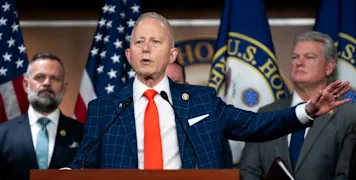
“It’s just bad to go into a very tight midterm election … and be hurting, you know, 20 some million people in the country,” Rep. Jeff Van Drew (R-N.J.) said.
“To do this is buffoonery,” Van Drew added, referring to Republican inaction. “I want to be in the majority next year, and this makes that much harder because of the districts that are so close.”
There are a handful of competing ideas circulating among Republicans, but there’s no consensus on which plan to coalesce behind.
Some plans would extend the subsidies for two years, some for one year. Almost all have new restrictions, though they differ on the specifics. And none addresses abortion, which is a significant stumbling block to any compromise.
Rep. Jen Kiggans (R-Va.) has introduced both a one-year extension and a two-year extension.
A pair of GOP lawmakers — Reps. Don Bacon and (Neb.) and Jeff Hurd (Colo.) — have championed a two-year plan. And Rep. Brian Fitzpatrick (R-Pa.) is racing this week to finalize a separate two-year proposal.
But none of them has won a commitment from GOP leaders to get a vote on the floor — a mistake, in the eyes of the moderates.
“The details of each individual plan are not as important as the desire to get it done,” Van Drew said. “I hate ObamaCare. … It’s wrong, it’s bad, it’s corrupt. However, in the short term: Fix it immediately, as quickly as you can. We only have a few weeks here.”
The White House floated its own plan to temporarily extend the subsidies for two years, paired with reforms similar to those included in the various House proposals. But the leaked framework was quickly pulled after a mountain of internal GOP criticism.
Johnson further undercut efforts to build momentum behind a particular plan when he told reporters Thursday that GOP leadership would be presenting its plan, and holding a vote by the end of the year.
It’s unclear whether ObamaCare subsidy extensions will be part of that package, but House Majority Leader Steve Scalise (R-La.) said it would not include a bipartisan framework for a temporary subsidy extension introduced Thursday by Kiggans and Josh Gottheimer (D-N.J.).
Rep. Kevin Kiley (R-Calif.), who supports the Kiggans and Gottheimer plan as well as his own, said it would be a “mistake” for GOP leadership not to hold a vote on the expiring subsidies.
“There is a strong majority that exists for doing something to stave off the worst outcomes here. I think there’s enough points of consensus in the various different ideas that we should be able to get a deal done,” Kiley said. “If people are forced to pay thousands of dollars more and are unable to afford insurance, then they’re going to hold Congress accountable.”
Centrists are looking to build bipartisan support for an extension of the subsidies — a Democratic priority — with some new restrictions aimed at conservatives, such as income-based eligibility caps and the elimination of plans without premiums.
Without congressional action, premium payments are set to spike for tens of millions of people starting Jan. 1 if the enhanced subsidies expire, and the most vulnerable Republicans up for reelection don’t want to be blamed.
Any idea needs to be bipartisan, since it will need 60 votes in the Senate to pass. House moderates are hoping at least one of their plans can be the basis of a compromise.
Senate Republicans promised Democrats a mid-December vote on a plan of their choice to extend the subsidies. That vote could happen as early as Dec. 9, leaving little time for lawmakers to come together on an alternative if it fails.
Senate Minority Leader Chuck Schumer (D-N.Y.) announced Thursday the plan would feature a “clean” three-year extension. That proposal keeps Senate Democrats squarely aligned with Democrats in the House, where party leaders are urging Republicans to join a discharge petition, with no success so far.
“The path forward that has the greatest number of votes in both the House and the Senate is a three-year extension,” House Minority Leader Hakeem Jeffries (D-N.Y.) told reporters Thursday. “Time has run out.”
But the three-year plan has little chance of winning the Republican support needed to become law, because it doesn’t include any of the reforms demanded by even the moderate GOP lawmakers.
“I don’t buy the three-year clean extension. That’s DOA.,” Bacon said. “Most of us want a one- or two-year extension that has some modifications on incomes, on various other things.”
The Senate Democratic plan “doesn’t acknowledge the flaw in the construct of the tax credits,” Fitzpatrick said. “You have to focus on the low- and middle-income earners. The current construct is [that] you can earn $600,000 a year and get subsidies. We’ve got to focus on the people that really need it.”
Fitzpatrick said his nascent proposal has a better chance because it already has bipartisan buy-in.
“It’s got House, Senate and White House input, from both parties. So that’s going to be our best product we can put together,” he said.
As a last-ditch effort, Fitzpatrick is prepared to introduce a discharge petition — which can force a vote on any bill if 218 House members sign on — if Johnson doesn’t bring the legislation up for a vote.
Getting a deal through the House and Senate is a political minefield. For the centrists, it’s not for lack of effort — though some admit that having so many competing ideas only makes it harder.
Bacon, who is retiring after next year, said he’s co-sponsored separate bills that are all slightly different in an effort to find common ground.
A temporary extension “is not solving the problem — it’s throwing more money at it. But we need to do something temporary, just so we can find something better.”
Bacon acknowledged the conservative objections over doing anything to help ObamaCare, but said that’s not a politically feasible option for most members.
“If you’re in an R+20 or R+30 district, you can do that. But I have a heart for the guys paying premiums,” Bacon said.
Copyright 2025 Nexstar Media, Inc. All rights reserved. This material may not be published, broadcast, rewritten, or redistributed.
For the latest news, weather, sports, and streaming video, head to The Hill.