





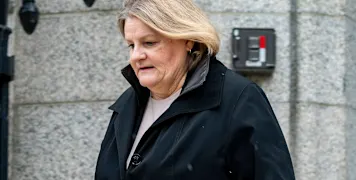
Milwaukee County Judge Hannah Dugan was found guilty of a felony count of obstructing federal agents seeking to make an immigration arrest outside her courtroom, a precedent-setting case that has been closely watched nationally and drawn passionate protests.
A jury of seven men and five women deliberated more than six hours before delivering a split verdict. They found the judge not guilty on a lesser misdemeanor charge of concealing a wanted person.
The case thrust Dugan, a judge for nine years, into the center of the clash between the judiciary and the Trump administration over its crackdown on illegal immigration.
“We weren’t trying to make an example out of anyone. This was necessary to hold Judge Dugan accountable because of the actions she took,” Interim U.S. Attorney Brad Schimel said. “There’s not a political aspect to it.”
Dugan attorney Steve Biskupic highlighted that the jury delivered a split verdict and the elements between the two counts are the same.

Dugan, 66, showed no emotion as the verdict was read.
“The case is a long way from over,” Biskupic said.
Biskupic said the team would be filing a motion asking Adelman to set aside the conviction, especially based on the split verdict. No sentencing hearing was set.
The jury foreperson, who did not provide his name, was asked how he was doing and said, “I am not feeling too good.”
“I will say the jury followed [Judge] Adelman’s instructions faithfully,” the foreperson said.
Other jurors declined to speak to the media.
Schimel urged people to “keep this case in proper perspective.”“Some have sought to make this about a larger political battle. While this case is serious for all involved, it is ultimately about a single day – a single day – in a public courthouse,” Schimel said.
Schimel also said courthouses are the safest place to make arrests, and it was safer than a traffic stop. He also said it appeared clear from Chief Judge Carl Ashley’s draft policy on courthouse ICE arrests that there was little that court officials could do to stop them.“The defendant’s actions provided an opportunity for a wanted subject to flee outside of that secure courthouse environment,” he said.
Before the trial, the government made a plea offer to Dugan, but no deal was struck. Details were not provided.
During their six hours of deliberations, the jury had three questions: one about ICE regulations and who needed to be told when agents were making an arrest. The next two were if Dugan needed to know who was being arrested. The answer Adelman sent back was different to the similar questions.
The jury was drawn from 12 counties that make up the Eastern District of Wisconsin, from Sheboygan to Kenosha and to the western border of Waukesha County.
The government brought in 19 witnesses, ranging from federal agents to a fellow judge. The defense called two fellow judges, a public defender and former Mayor Tom Barrett, a longtime friend. Dugan herself did not take the stand.
The case against Dugan was factually simple and could be legally monumental. This is the first time a state judge has gone to trial on charges of obstructing immigration agents.
The case has become a bellwether in the clash between the judiciary and the Trump administration as it executes a sweeping immigration crackdown nationwide.
Case began with an ordinary day in state court
On April 18, Dugan was presiding over a misdemeanor court on the sixth floor of the Milwaukee County Courthouse.
Tensions were high among county judges as federal immigration officers had earlier arrested two people suspected of being in the country illegally.
Federal agents were there to arrest Eduardo Flores-Ruiz, 31, charged with battery and appearing before Dugan. Flores-Ruiz illegally re-entered the U.S. in 2013.
Dugan learned of the planned arrest from her clerk. She went to the main corridor with another judge, questioned the agents, and directed them to the chief judge’s office, who was working on a plan on how such arrests were to be treated.
Dugan returned to her courtroom, moved Flores-Ruiz’s case up first and then directed Flores-Ruiz and his attorney through a non-public door and into a hallway used by judges and staff, witnesses testified.
Flores-Ruiz and his attorney emerged into the public corridor. Federal agents followed them. He was arrested outside the courthouse after a brief foot chase.
A week later, FBI agents arrested Dugan, leading her out of the Milwaukee County Courthouse in handcuffs. Flores-Ruiz has since been deported.
Prosecutors focused on five acts, avoided politics
The sides largely agreed on the basic facts of what happened. The question centered on Dugan’s intent.
Federal prosecutors used the indictment as a roadmap for their case, highlighting things they said Dugan did that were unusual, even in a busy courtroom.
They also used video of Dugan’s interaction with the agents and audio from inside the courtroom to paint a picture of a judge bent on defying the ICE agents.
Dugan’s court reporter offered to walk out the pair but Dugan says she’ll do it. “I’ll get the heat.”
Judge Kristela Cervera was a key witness, testifying that she was reluctant to go in the hallway with Dugan and she was shocked to learn the allegations against Dugan.
“Judges should not be helping defendants evade arrest,” Cervera testified.
On cross-examination, Cervera admitted she texted her sister, a lawyer, after the incident to warn her that ICE agents were in the building. Defense attorneys said she helped the government in order to save herself. The government downplayed the text to her sister.
Defense questions the details
President Trump’s name came up just a couple of times in the trial, but his stepped-up immigration enforcement was a theme throughout the defense strategy.
Dugan’s attorneys said the Trump administration was trying to make an example out of Dugan to “crush” her.
They described Dugan as an earnest public servant trying to follow guidance on how to handle such arrests, not trying to obstruct agents.
Several of the actions the government called criminal are things that happen every day in the bustling state court, her attorneys argued.
Dugan’s team tried to get the case tossed out, arguing that as a judge, she was immune from prosecution. U.S. District Judge Lynn Adelman denied their motion, though the team preserved its ability to make that argument later.
Reporter Hope Karnopp contributed to this article.
(This story was updated to add new information.)
This article originally appeared on Milwaukee Journal Sentinel: Milwaukee County Judge Hannah Dugan found guilty of felony obstruction