





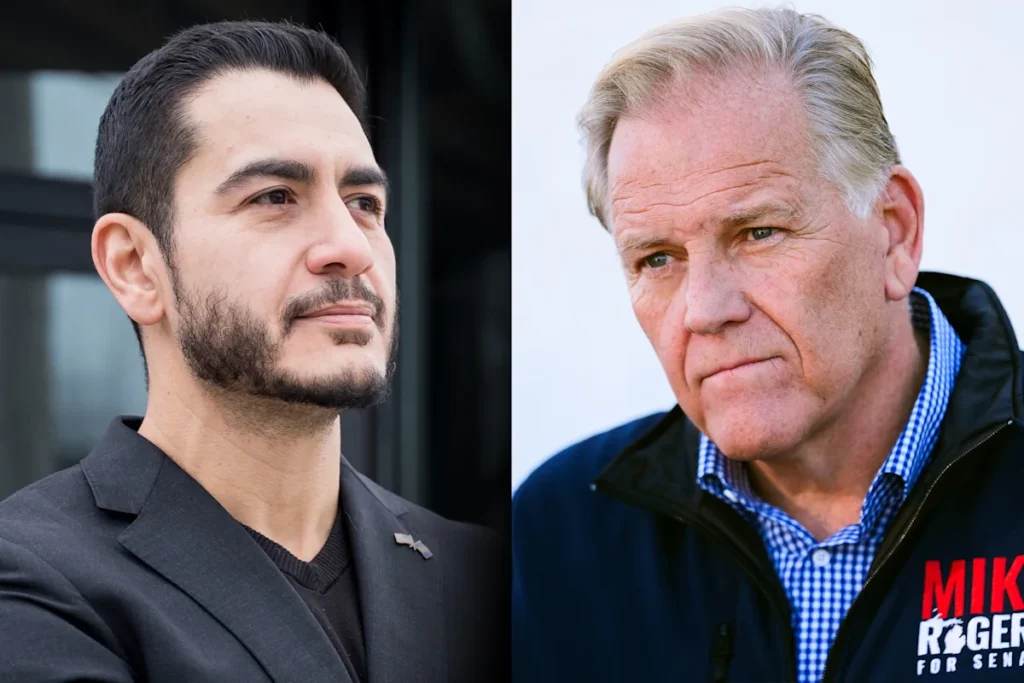
On Election Day, Democrat Abdul El-Sayed and Republican Mike Rogers will face off in what may be the marquee battle of the 2026 midterms: the race to succeed retiring Democratic Sen. Gary Peters in Michigan.
It’s a contest that could decide which party controls the U.S. Senate.
Democrats currently hold 47 Senate seats, including two independents who caucus with them. They need 51 to win back the chamber. (A 50-50 split would give Vice President JD Vance the tiebreaking vote.) Polls suggest that flipping four Republican seats is very possible, but Democrats are also playing defense in Georgia, New Hampshire and Michigan. The Great Lakes State looks like the closest of the three.
Democrats are pinning their hopes on El-Sayed, an unapologetic 42-year-old progressive who’s pushing policies such as Medicare for All and ending U.S. military aid to Israel; who’s willing to confront his critics and his own party’s establishment; and who’s vying to become America’s first Muslim senator.
Republicans have handed the reins to Rogers, a 63-year-old former congressman who lost an extremely close Senate race to Democratic Sen. Elissa Slotkin two years ago, and who has since broken with President Trump on tariffs and the war in Iran.
The race has been rocked by several controversies, and the biggest came Sunday, two days before the election. Rep. Haley Stevens, the Democrat El-Sayed narrowly defeated in the primary, endorsed Rogers after the two worshipped together at Perfecting Church in Detroit.
“Our Democratic nominee for Senate said I was no longer welcome in his campaign and that I should stay away,” Stevens said in a video. “And he’s right. And that’s why I am endorsing Mike Rogers for the United States Senate today.”
Stevens had said days earlier that she would vote for El-Sayed, and the two were due to appear together Sunday for the first time since August. That plan collapsed after she called on him to condemn an outside group’s ad tying U.S. support for Israel to grocery prices. His campaign then asked her to stay away, NBC News reported.
Defending her stance, Stevens told CNN on Sunday the decision was a “weight off my shoulders” and said she had decided to switch allegiances because El-Sayed had been getting “angrier and angrier” throughout the campaign.
When Stevens announced her change in support for Rogers, she maintained that she was “still a very proud Democrat.” Michigan’s Democratic Party chair, Curtis Hertel, fumed over the decision in a Sunday post on X, writing, “Congresswoman Stevens is not a current member of the Michigan Democratic Party, nor will she be in the future.”
Trump told a rally in Iowa on Sunday that he’d “love” Stevens to join the Republican Party and said she’d been “very brave” to endorse Rogers.
Rep. Debbie Dingell, who helped arrange the event, told the AP before the endorsement that she had called it off. “I’m the one who pulled it because it had become way too distracting,” she said.
“I would rather not distract from the key issues of this campaign,” El-Sayed said Saturday. He attended a different Detroit church Sunday with Dingell and other Democrats, and did not address the dispute there, the AP reported. Stevens’s longtime chief of staff resigned after the church visit, and more staff were expected to leave, the AP reported, citing a person familiar with the matter.
On Sunday, El-Sayed spoke with reporters before a unity event with other Democrats and reacted to Stevens’s endorsement, saying, “At the end of the day, I actually don’t think about Haley Stevens.”
“This is a state of 10 million people who deserve a lot better from their government. I’m a lot more focused on the 9,999,998 that are not the ones you guys are talking about,” El-Sayed said, referring to Stevens and Rogers.
Senate Minority Leader Chuck Schumer wrote on social media on Sunday that Stevens’s reversal was a “despicable betrayal.”
Jason Turkish, Stevens’s fiancé, said last week that he would vote for Rogers because of El-Sayed’s criticism of Israel’s conduct in Gaza.
“Every time [El-Sayed] talks about genocide, Jews get death threats,” Turkish, a Michigan lawyer and registered Democrat, claimed Oct. 28 at a Rogers campaign event. “We have never seen a candidate for U.S. Senate act so recklessly toward the safety of Jews in the community as we have seen from Abdul.”
Further raising the stakes is the fact that Michigan couldn’t be more purple, having swung to Trump in 2016, then Democrat Joe Biden in 2020, then back to Trump in 2024 — always by slim margins.
Here’s everything you need to know about the Michigan Senate contest.

Who’s winning? Here’s what the polls say.
Twelve polls have been conducted in October. Eleven of them have shown El-Sayed with leads ranging from 1 to 7 percentage points. New surveys from both CBS Detroit and CNN give El-Sayed a 7-point lead. The only recent poll to show Rogers ahead (by 2 points) was sponsored by a group affiliated with the former congressman. All of those polls were taken before Stevens’s endorsement.
To close the gap on Election Day, Rogers has been reaching out to two groups who backed Stevens over El-Sayed in the primary: Black and Jewish Democrats.
In August, Stevens won a majority of Michigan’s large counties with significant Black populations by an average of 8.5 percentage points. She also won Detroit with more than 60% of the vote, making El-Sayed the first Michigan Democrat since 2018 to win a statewide primary without winning the state’s largest city.

El-Sayed shakes hands with former President Barack Obama during a campaign event on Oct. 24, 2026, in Detroit.
(AP Photo/Paul Sancya)
Some members of Michigan’s Jewish community also gravitated toward Stevens because El-Sayed has called the war in Gaza a “genocide” and accused Democrats who refuse to do the same of lacking the courage necessary “to stand up to Donald Trump.”
“Killing tens of thousands of people makes you pretty damn evil,” El-Sayed told CNN in April. “It’s not how evil is this one versus that one. Hamas: evil. Israeli government: evil. We can say both.”
It remains to be seen whether Rogers’s outreach will pay off; he’s also targeting more reliable Republican constituencies such as the nearly 4 million Michiganders ages 50 and older. So far, polls suggest that El-Sayed’s strategy — trying to maximize his support among anti-establishment voters, Arab Americans and young voters — has put him ahead in the polls.
But the polls have overestimated El-Sayed before. In the run-up to August’s primary, several surveys showed El-Sayed with a double-digit lead over Stevens. The race ended up being much closer than expected, with El-Sayed edging Stevens by less than 1 percentage point.
How controversial has the race been?
El-Sayed’s background has also made him the target of persistent attacks from Republicans, with Trump going so far as to call him a “jihadist” and accuse him of being “on the side of the terrorists.”
Vice President JD Vance recently said El-Sayed had “zero attachment” to the United States. El-Sayed is a U.S. citizen who was born and raised in Michigan. Rogers has claimed without evidence that El-Sayed has supported the Muslim Brotherhood, one of the Arab world’s oldest and most influential Islamist groups.
In a recent exchange at a town hall with a critic who asked him whether he denounced the Muslim Brotherhood, El-Sayed highlighted what he called the “implicit” suggestion in the question: the assumption that he’ll have “dual loyalties” because of his faith.
“I’m not running to be a Muslim senator,” he said. “I’m running for the U.S. Senate and happen to be Muslim.”
After Trump referred to El-Sayed as “Mohammed” — his middle name — the Democrat responded in what has become his signature pugnacious style.
“I don’t care how he pronounces my name,” El-Sayed said during a rally in Grand Rapids on Oct. 25. “Because he can just go on and call me ‘senator’ after November. I will be Senator Mohamed to you, bro.”

Trump watches a video of El-Sayed during a campaign rally on Oct. 25, 2026, in Port Huron, Mich.
(AP Photo/Julia Demaree Nikhinson)
Meanwhile, El-Sayed has campaigned with Hasan Piker, a Marxist streamer whom other Democrats have called antisemitic and even anti-American.
“If perfectly inoffensive won elections, then Donald Trump would never have been president,” El-Sayed said in April when reporters questioned his choice of allies.
An independent left-wing group affiliated with Piker’s uncle, commentator Cenk Uygur, also recently released an ad linking U.S. support for Israel to high grocery prices. The ad shows two parents shopping for their kids’ lunch items; the mom tells the dad to put a carton of eggs back on the shelf.
“They don’t like eggs anymore?” the dad asks.
“No, they like eggs,” the mom answers. “But we have to set that $7 aside for killing Palestinians.”
Some Democrats and Republicans have urged El-Sayed to denounce the content of the ad rather than just distancing himself from it.
“That has nothing to do with our campaign,” El-Sayed said of the ad. “It’s certainly not what I want to be talking about right now.”
Who is El-Sayed?
El-Sayed, 42, was born on Halloween 1984 in Rochester Hills, Mich. — a northern suburb of Detroit. His parents were immigrants from Egypt, and his first language was Arabic. He captained his high school’s wrestling, football and lacrosse teams, then continued to play club lacrosse at the University of Michigan, where he majored in biology and political science.
El-Sayed went on to study medicine at Michigan, Oxford University (as a Rhodes Scholar) and Columbia University, where he received his MD. Before politics, he pursued a career in public health epidemiology as a tenure-track professor, and later led the Detroit health department.
In 2017, El-Sayed, then just 32, resigned as Detroit’s health director to run for governor. He said at the time he was inspired by his work on the Flint water crisis. He was endorsed by prominent progressives — Bernie Sanders and Alexandria Ocasio-Cortez — but lost the Democratic primary to Gretchen Whitmer by more than 20 percentage points.
After a stint as Wayne County health director, El-Sayed decided to try again in 2026. He has since become the most prominent Democratic insurgent to channel left-wing disillusionment with politics and outrage over Israel’s actions in Gaza to win his party’s nomination in a state where more moderate candidates typically prevail. His argument is that even in so-called purple states such as Michigan, Democrats have a better shot at success when they pick buzzy, big-swing progressives over safe, “electable” incrementalists.
Who is Rogers?
Rogers was born in Livingston County, Mich., in 1963. He earned a bachelor’s degree in criminal justice and sociology from Adrian College in 1985 before joining the Army. After four years of military service, Rogers joined the FBI as a special agent based in Chicago. His work with federal law enforcement focused on countering organized crime and public corruption. Rogers began his political career in 1994, when he was elected to a seat in the Michigan state legislature. He served for six years before launching his first bid for Congress.

Republican Sen. Tim Scott of South Carolina campaigns for Rogers in Muskegon, Mich., on Oct. 30, 2026.
(AP Photo/Paul Sancya)
Rogers was elected to the House of Representatives in one of the closest races of the 2000 election cycle, defeating Democrat Dianne Byrum by just 111 votes. During his 14-year tenure in the House, Rogers was a key conservative voice on national security and intelligence issues. He spent four years as chairman of the powerful House Intelligence Committee, much of that time focused on what he describes as “the economic and national security danger posed by China.”
Rogers left Congress in 2015 and quickly began a career in media. He hosted a daily syndicated radio show called Something to Think About with Mike Rogers and worked as a commentator for CNN.
Rogers returned to run for the Senate in 2024. Roughly six months after that loss, he announced his plan to run again in 2026.
Rogers is a conservative Republican on most issues — including abortion, immigration and transgender rights — but his opinion on Trump has shifted through the years. Over the past few weeks, Rogers has retreated from his early support for the president on two key issues: calling for Trump to end the “tariff war” with Canada and saying the conflict in Iran should also “end quickly.”