





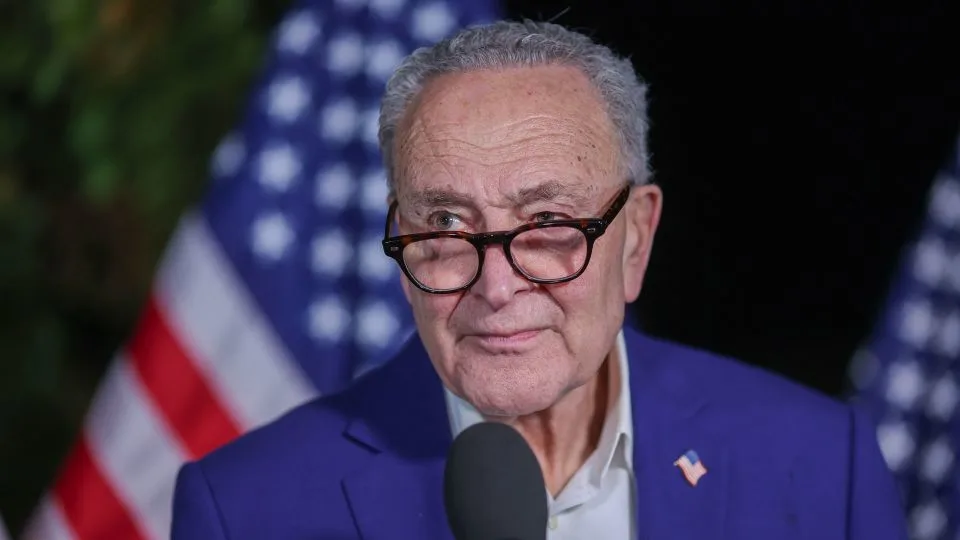
Chuck Schumer is confident he’ll continue leading Senate Democrats after they captured the chamber’s majority in dramatic fashion on Tuesday. Not all Democrats are so sure.
During a post-election gathering Saturday in Washington, DC, two Senate Democrats — Chris Van Hollen of Maryland and Elissa Slotkin of Michigan — declined to back Schumer for the job, and Slotkin said she would not rule out running herself. A third Senate Democrat who appeared at the conference, Sen. Mark Kelly of Arizona, said he planned to support Schumer but echoed calls for Senate Democrats “to do things differently than we’ve done before.”
“There should be no coronation of the next Democratic leader,” Van Hollen said. “I’ve said very clearly that we need to have a discussion in the Democratic caucus, we need to understand what the Democrats are going to do with this new responsibility and these new powers, and nobody should get a blank check without a full understanding of the caucus as to where we’re going to go.”
Van Hollen said he has urged Democratic colleagues to “withhold commitments” until Schumer outlines his vision. And Slotkin said Democrats should not give Schumer quorum — the minimum attendance required to conduct Senate business — until he answers their concerns.
Schumer remains a heavy favorite to become majority leader. He has no declared opposition and needs to win only majority support from Senate Democrats, whose ranks are poised to grow to at least 54 seats after Tuesday’s elections.
But Saturday’s comments showed how even Democrats’ sweeping midterm victories could not paper over their long-simmering disagreements about who is best to lead them. That debate may be especially elevated among Senate Democrats looking at potentially running for president in 2028, a group that includes Van Hollen, Slotkin and Kelly.
In addition to the reservations among the returning Senate Democrats, several incoming freshmen have vowed not to back Schumer for leader or at least withheld their support for now. Scott Colom, the Democrat in a Senate race in Mississippi that remains too close to call, has also been noncommittal on Schumer, calling for more geographic diversity among party leadership.
In an interview with The New York Times that published Friday, Schumer said he did not expect to face any opposition.
“Our caucus is focused on moving forward,” Schumer told the newspaper’s “The Daily” podcast. “Everyone’s very happy with what we all did.”
Several Senate Democrats have already said Schumer has earned his right to return as their leader after the better-than-expected outcomes in Senate races. Kelly added his name to that list Saturday.
“Chuck worked really hard to get this majority, so my plan is to support him,” Kelly told reporters after his appearance at the post-midterms summit, Crooked Con.
Slotkin struck a different tone as she addressed the conference, which booed and jeered at the mention of Schumer’s name throughout the day.
“If he wants to be majority leader, what is your plan for the first 100 days?” she said. “How are you going to do things differently so that Democrats get their sh*t together? If you can’t produce that, I’m not voting for you.”
Asked whether she would run for the top job, Slotkin said it was “an open field, and I think those conversations are happening rapidly.”
“I’m not ruling anything out,” she said.
Van Hollen, for his part, suggested he was unlikely to run, even though at least one incoming freshman — Abdul El-Sayed of Michigan — has said he could support him. Van Hollen told CNN on Saturday that running for majority leader was “not my focus” and that he was instead weighing a 2028 presidential campaign. He said he has not heard “directly” from Schumer since the midterms but expected to speak to him in the coming week.
Slotkin, who has long called for a “new generation of leadership,” said she hopes incoming freshmen follow the example she set in her first House run in 2018. She campaigned promising not to support Nancy Pelosi for House speaker — and followed through when she voted present in the speaker’s election in January 2019.
“These people who just won in tough places, I think, will have a hard time, both as leaders but also just as politicians, going back on their word as their first thing that they do,” she said.
For more CNN news and newsletters create an account at CNN.com