






The dust has almost settled on the Democratic Party’s 2026 midterm landslide — almost. It’s clear that Democrats won sweeping victories in the U.S. House, Senate and statehouses nationwide.
But some key races remain too close to call, including Senate brawls in deep-red Mississippi and Alaska; Rep. Lauren Boebert’s reelection battle in Colorado; and other nail-biter House contests across the South.
Here’s the latest on how many seats Democrats have won so far — and where things stand in all of the unresolved races.
How many Senate seats did Democrats win?
Democrats came into the midterms needing a net gain of four seats to win back the Senate. To do that, they had to defend a handful of potentially vulnerable swing-state seats while also flipping at least a few seats in historically red states.
That’s exactly what happened. Republican efforts to flip blue seats in Michigan, Georgia, Minnesota and New Hampshire all came up well short. Meanwhile, Democrats secured victories to flip seven GOP-held seats in Maine, Texas, South Carolina, Ohio, North Carolina, Iowa and Kansas.
Only two incumbent Republican senators in races that drew significant attention were able to win reelection: Florida’s Ashley Moody and Nebraska’s Pete Ricketts.
As it stands, Democrats will enter 2027 with at least 54 seats in the Senate. They have already gained seven seats to give themselves, at minimum, a four-seat majority. Their majority could grow to six if the two remaining undecided races in Alaska and Mississippi go their way.
Where things stand in the undecided Senate races
Both races are extremely close, with no clear indication of when they might be decided.
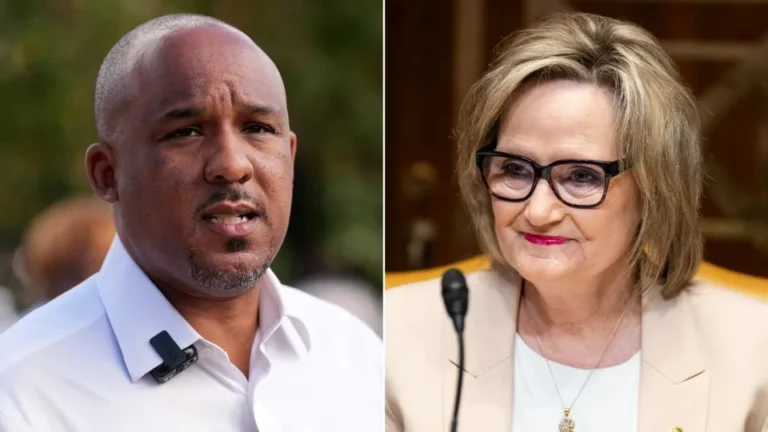
In Mississippi, Democrat Scott Colom’s lead over Republican incumbent Cindy Hyde-Smith had grown to 2,536 votes as of Monday evening, according to the Associated Press. Outstanding absentee ballots in the race must be received by Tuesday in order to be counted, according to Mississippi state law.
Colom’s lead — which stood at just 65 votes on Election Day — has widened gradually in the days since. Even though 97% of the vote is in, AP has yet to call the race because the gap between Colom and Hyde-Smith remains narrow — just 0.27% of all ballots cast.
Alaska’s ranked choice voting system means it could take significantly longer for a winner to be declared. As it stands, Democrat Mary Peltola holds a lead of 637 votes over Republican incumbent Dan Sullivan, with 74% of ballots counted. The state is expected to have counted nearly all ballots by Nov. 13, with the last remaining votes tallied by Nov. 18.
The wait for a final result could become extended if neither Peltola nor Sullivan receives more than 50% of the total first-choice votes. That would trigger a count of ranked choice votes to determine the winner. Under Alaska law, the ranked choice tally cannot begin until Nov. 18, which means a winner wouldn’t be declared until two full weeks after Election Day.
How many House seats did Democrats win?
So far, Democrats have won 254 U.S. House seats — far more than the 218 they needed for a majority. That includes 44 red-to-blue flips. Democrats’ 13-point victory in the House popular vote (so far) has been the largest in any midterm since 1974.
Where things stand in the undecided House races
On Monday afternoon, incumbent GOP Rep. Mario Diaz-Balart of western Miami defeated Democratic challenger Nicole Locklin by about 1,700 votes in Florida’s 26th Congressional District.
Another 20 U.S. House races remain unresolved.
Two of them are in Louisiana, which holds open, nonpartisan “jungle primaries” on Election Day, then sends the top two finishers to a Dec. 12 runoff if no one gets a majority of the vote. One Democrat and one Republican will now go head-to-head next month in Louisiana’s 5th and 6th Congressional Districts.
In California’s 4th and 7th Districts, only Democrats are competing. Officials are still counting ballots in all three races. California also has a nonpartisan jungle-primary system where members of the same party can advance to the general election.
Of the remaining 15 races, Democrats lead in five.
In Colorado’s 4th Congressional District — long considered one of the state’s safest Republican seats — GOP firebrand Lauren Boebert trails Democrat Eileen Laubacher, a retired rear admiral in the Navy, by more than 3,000 votes with just 2% of the vote left to count. After a close 2022 reelection fight in her previous district, Boebert switched to the 4th District for her 2024 campaign and won by about 11 percentage points. Colorado counties have until Nov. 13 to count ballots and upload final results. Right now, Laubacher’s lead is too big to trigger an automatic recount.
Democrats’ next-largest lead is in central Florida’s 9th Congressional District, where incumbent Democrat Darren Soto — who was targeted by GOP redistricting efforts — leads Republican challenger Dan Green by roughly 1,500 votes with more than 99% of the vote counted. The state of Florida has announced there will not be a recount in the 9th District because Soto’s lead falls outside recount requirements. Soto is expected to win.
Democrats’ other leads are in Tennessee’s 4th Congressional District, Minnesota’s 1st Congressional District and North Carolina’s 5th Congressional District. The margins in these races are in the 100- to 300-vote range. A recount is likely in Minnesota.
Republicans lead in the other 10 unresolved races.
Two of the closest are in Florida. Republican Ryan Elijah leads Democrat Bale Dalton by about 1,600 votes in Florida’s 7th Congressional District — enough to avoid a recount under Sunshine State law. Meanwhile, Miami-Dade County election officials began a machine recount Monday in Florida’s 27th Congressional District, where Republican Rep. María Elvira Salazar leads Democratic challenger Eliott Rodriguez by 1,090 votes, or 0.44 percentage points. That’s within Florida’s automatic half-point threshold.
Nearly all of the other uncalled races where Republicans lead feature incumbent GOP lawmakers fending off strong challenges in reliably red areas: North Carolina’s 3rd, 7th and 10th Districts; South Carolina’s 2nd District; California’s 23rd District; Washington’s 5th District and Alaska’s only congressional district. The Western states are still waiting on big batches of mail ballots; the Eastern states have mostly finished counting.
Republicans’ only remaining pickup opportunity is Maine’s 2nd Congressional District, where a conservative Democrat retired — and where former GOP Gov. Paul LePage now leads Matt Dunlap, the progressive state auditor, by more than 5,000 votes with just 2% left to count. A ranked-choice vote count will continue in the state despite Dunlap conceding to LePage on Nov. 5.
How many governorships did Democrats win?
Republican governors have outnumbered their Democratic counterparts for the last 15 years straight (and for 26 of the last 30 years overall). That’s given Republicans more opportunities to experiment with new policy ideas, approve congressional maps, influence election procedures, fill Senate vacancies and build executive experience.
But this year, Democrats have reversed the “governor gap,” flipping five governorships in Iowa, Texas, Ohio, Nevada and Georgia to bring their total to 29 — the party’s first gubernatorial majority since 2011.
Where things stand in the undecided governor’s race
Kansas is anything but a blue state; since 1940, it has voted Republican in every presidential election but one — Lyndon B. Johnson’s 1964 landslide. But the Sunflower State has elected two Democratic women governors in recent years: Kathleen Sebelius (2003-2009) and term-limited incumbent Laura Kelly (2019-2027).
State Sen. Cindy Holscher is seeking to become the third.
Holscher leads Republican Ty Masterson, the president of the state Senate, by more than 7,500 votes with nearly all of the ballots counted. Holscher declared victory on Nov. 4, saying that “the people of Kansas made their voices heard, and I’m deeply honored by the trust Kansans placed in me to serve as your next governor.”
But the race won’t be officially over until all 105 Kansas counties complete a legally mandated close-race audit. Masterson said last week that he wouldn’t concede before the audit was done. A source close to the Republican senator told the Kansas City Star that Masterson “did not plan to pursue an additional recount and would accept the results if Holscher’s narrow win was finalized.”
Counties will certify their results on Nov. 15.
In Alaska, three Republicans and a Democrat are running to replace Republican Gov. Mike Dunleavy.
Democratic candidate Jonathan Kreiss-Tomkins is currently leading, with 49.6% of the vote. Republican Bernadette Wilson is in second, with 29.2% of the vote, with fellow GOP candidates Dave Bronson and Treg Taylor further behind. 76% of the vote has been counted.
How many state legislatures did Democrats win?
Democrats’ gains were also seen at the state level. They flipped more than 500 state legislative seats across the country and turned a total of 12 legislative chambers blue.
That includes three states where they flipped both chambers: Arizona, New Hampshire and Wisconsin. After Election Day’s results, Democrats will control the House, Senate and governorship in Arizona for the first time since 1966. Democrats also secured a “trifecta” in Wisconsin. They’ll hold both legislative chambers in New Hampshire, but the governorship in the Granite State will remain in Republican hands.
Democrats regained trifectas in Minnesota, Michigan and Pennsylvania by clinching majorities in the lone GOP-led chamber in their states. They flipped a single chamber in Georgia, North Carolina and Texas, ensuring that Democratic governors in those states won’t face unified Republican opposition within their state legislatures.
Where things stand in the undecided state legislative races
As of Monday evening, only three state legislative chambers — the North Carolina Senate and both chambers in Alaska — remained undecided, according to the AP.