




The trucks, they just keep getting bigger. A modern Ram 1500 is upwards of a half-foot longer than a Cadillac Escalade, and with each generation they just keep growing. With that extra size comes more capability — larger payloads, heavier trailering, roomier seating — but lately, we’re seeing a new breed of big truck built for one thing: speed.
Blame the Ford F-150 Raptor, which over a decade ago kicked off the trend of trucks you could drive off the showroom floor and straight into the dunes of Baja. That spawned a whole family of machines from the Blue Oval, plus plenty of wannabes. Ram’s first attempt was the TRX in 2021, a truck that had the requisite speed and size — but with over 700 horsepower from a supercharged V8 and a six-figure price tag to match, it was just a little too much for many buyers.
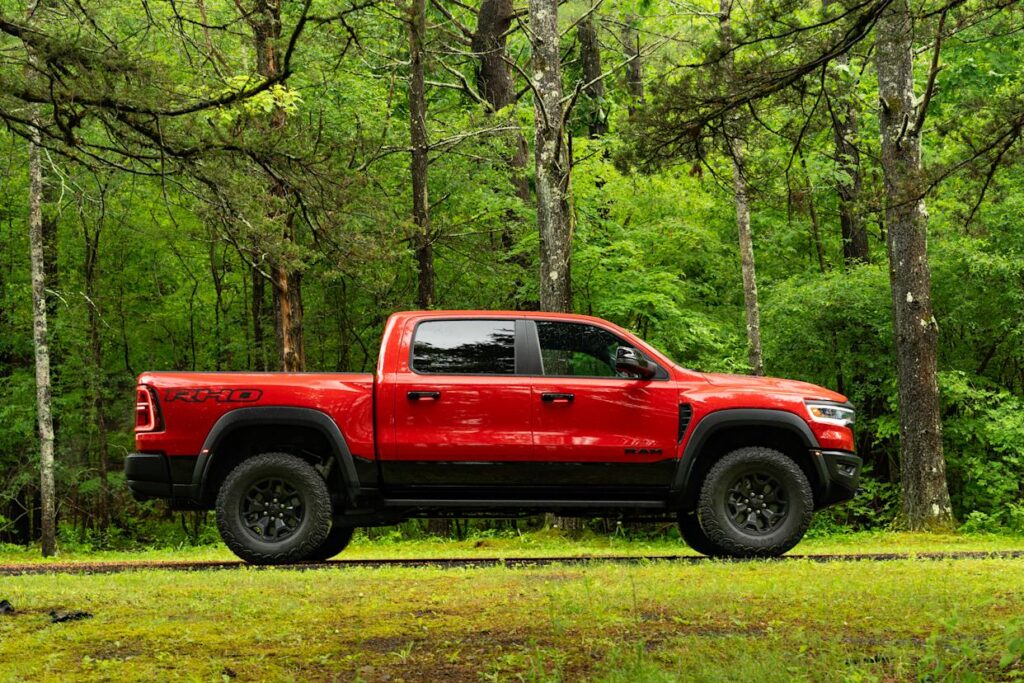
Meet the second attempt: It’s the Ram 1500 RHO. This model shares much of the same concept and hardware as the TRX, but this time is powered by a 3.0-liter twin-turbocharged V6. That makes a relatively manageable 540 hp and results in a much more attainable $69,995 MSRP. It’s still loaded with enough drive modes and sources of telemetric data to keep the most data-hungry of off-roaders happy. But can it compete with the big daddy of them all, the Raptor?
Ram RHO: Crucial statistics
On paper, things certainly look good for the Ram. It has an almost 90 horsepower advantage over the Raptor, and its 521 pound-feet of torque just edges the 510 lb-ft in the Ford. For those who actually want to work with their truck, the RHO has a slight advantage of 8,380 pounds of towing vs. the Raptor’s 8,200.
Modern performance trucks like this must also be littered with performance-enhancing technologies, endless drive modes, and traction management systems designed to help owners carry speed through any condition. The RHO offers four general-purpose modes: Sport, Tow, Snow, and Auto. Then there are three more terrain-specific options: Baja, Rock, Mud/Sand.
Finally, there’s a Custom mode, where you can specify the aggression of the transmission, suspension, steering, and stability control system, plus enable or disable the big shiny shift paddles mounted behind the steering wheel.
Really, though, all the modes are custom, as you can modify any of them to your heart’s content. But it goes way deeper than that. You can configure custom shift lights so that the blinkenlights on the dash illuminate at specific RPMs. You can even tweak the truck’s launch control as well in 100 RPM increments, ensuring that it has just the right amount of spin to launch you forward.
Fast truck, slow software
Launch control is enabled via a dedicated button on the dashboard, one of an endless array of controls that festoon this truck, including four separate aux buttons. With these you can control enough aftermarket lights to blind any poor soul that crosses your path. Mind you, the RHO is positively littered with identification lights already, but I have a feeling that a few owners will want even more.
It sometimes takes multiple seconds for the truck to respond to changing mode buttons. The same goes for tapping through those endless pages of data, some taking so long to pop up that you’ll swear everything has locked up. It’s exacerbated by the lengths you’ll need to travel to find what you’re looking for. Many options are buried two or three menus deep, compounding the latency with each tap.
The interface on the dedicated passenger display on the far right of the dashboard is likewise sluggish. Your (hopefully patient) co-driver can do things like pair devices or enter addresses into the navigation while underway, which is useful because the truck’s integrated voice assistant is remedial at best. After three attempts, it managed to find me a Starbucks, but it completely failed to understand my address and was flummoxed by requests like “I’m hungry” or “I need a hospital.”
Your passenger can also bring their own device and stream to that dashboard display via HDMI, thanks to display technology that prevents the driver from seeing what’s going on. That’s just one of the dozens of ports littered around this truck’s interior, including seven USB ports and dual wireless chargers up front, another four USB ports in the rear, and two three-prong 110 outlets.
It provides plenty of power to keep everyone’s devices juiced and plenty of room for everyone to stretch out. The RHO seats five comfortably, with heated and ventilated seats front and rear. There’s even massage in the front seats if you spring for the $9,995 Customer Preferred Package, which also includes a stellar 19-speaker Harman Kardon sound system. It’s crisp and sharp and yet powerful enough to annoy the neighbors.
On the road with the Ram RHO
If you look at the Ram RHO and don’t feel immediately inspired to leave your life behind in pursuit of a career in desert racing, there’s something dead inside you. The whole thing just screams adventure. It’s covered in extra creases and vents and graphics, plus the aforementioned LED lights, ensuring that this thing doesn’t just stand out due to its prodigious dimensions.
It’s a big truck, and it drives like one. Winding through a narrow parking lot is a task best done with generous use of the truck’s 360-degree camera. It’s just a shame that the camera takes so long to enable, thanks again to the woefully sluggish software.
It didn’t feel particularly happy on the road, either. Regardless of which suspension setting I chose, the RHO felt constantly unsettled. It powered over the worst of my local railroad crossings smoothly, but took a good two or three compressions and rebounds before it finally settled again on the other side. Mid-corner bumps likewise made the truck feel very unsettled.
Still, the RHO is a calm and composed cruiser on the highway, the eight-speed transmission ensuring that the big engine will sit barely above idle during your morning commute. That’s about the only thing helping this truck’s fuel economy, which clocks in with an official 15 mpg combined rating. In my mixed testing, I came in just short of 13.
So it’ll be an expensive cruiser, and there’s also a fair bit of drone from those big tires to deal with as well, but the truck tempers that with a solid offering of active safety systems. That includes a hands-off adaptive cruise and lane-centering system that’ll steer the truck for you so long as you keep your eyes on the road.
Which to choose? In my book the RHO is the better looker but the Raptor is the better daily driver. The Ford is also far more expensive, coming at nearly $10,000 over the RHO. That’s a lot extra to spend, especially considering it’s down nearly 100 hp. It’s not an easy decision, but given the preponderance of Raptors everywhere you look, for anyone looking to break out from the crowd, the RHO might just be that little bit harder to ignore.