





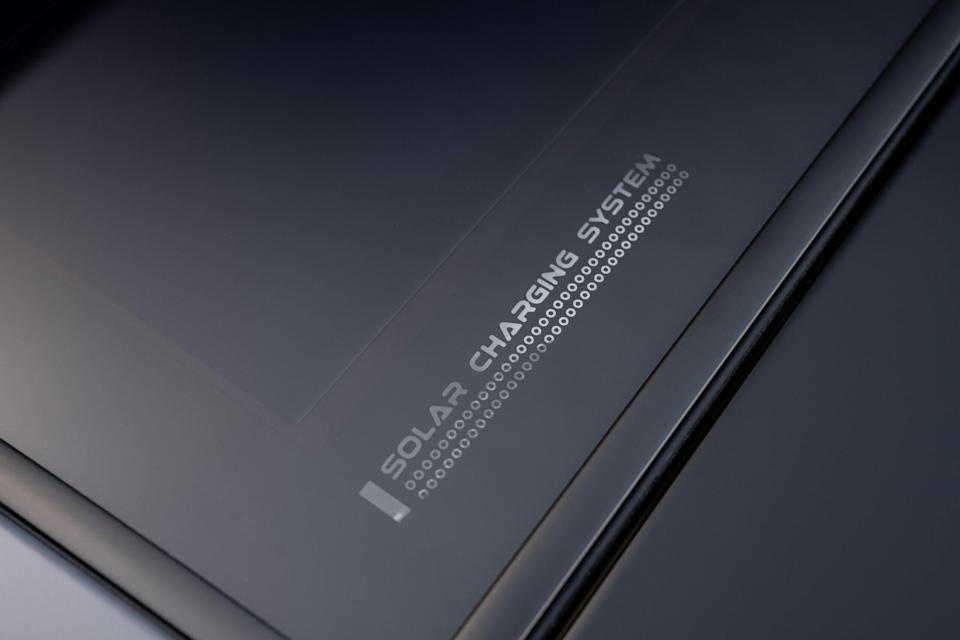
Solar features on automobiles have always held an appeal. It’s hard to look at that gleaming surface area and not imagine that with a few solar panels, freely generated power could be put to good use.
Car-based solar power has had its moments. Toyota has offered the Prius with an available solar roof no less than three times since 2010.
Hyundai included a solar roof option on the 2020 Sonata Hybrid Limited. And Fisker developed a retractable solar moonroof for the top trim of its all-electric Ocean SUV, launched in 2023.
The Fisker solar roof, developed with Germany’s Webasto Group, could deliver up to 1,500 miles per year of charge to the vehicle’s high-voltage battery, in locations where sunny days were more common than cloudy ones. Fisker went out of business in 2024.
In ideal conditions, the roof on the Sonata Hybrid Limited was good for about four extra miles a day. Early versions of the technology on the Prius could only support in-vehicle functions, such as cabin ventilation. But the most recent solar roof application, available only on the 2025 Prius XSE Premium trim for $610 extra, matches the Sonata’s capability.
Driving daily and parking in sunlight with such a system adds 1,400 to 1,500 miles of range a year. That’s a big step up from a decade ago when solar panels powered small fans rather than increased range.
That doesn’t mean companies have abandoned the concept. Rather, they are reassessing.
“Solar technology is not inexpensive,” said Cooper Ericksen, senior vice president of product, battery-electric vehicles and mobility planning and strategy for Toyota North America.
“The idea is amazing, but customers expect more out of it,” Ericksen said. “It’s a technology we’re continuing to study. If you can get five to 10 free miles from the feature, it doesn’t take long to pay off for the consumer.”

While solar roofs are appealing, panoramic moonroofs tend to be more popular, Ericksen said. Incorporating solar capabilities into paint, moving them from the roof to the vehicle’s body to increase surface area and bolster power generation, might be a future advancement, he said. A payoff time of two to three years for a solar feature would move the needle for cost-sensitive consumers.
Hyundai phased out solar roofs for U.S. vehicles
Hyundai has offered the feature with the Sonata Hybrid Limited, as well as a version of the Ioniq 5 EV sold outside the U.S., but discontinued it.
“While the technology modestly improved driving range and has since appeared on other Hyundai models globally, it was eventually phased out,” the company said in a statement.
There’s another issue, Ericksen said. For solar features to offer any meaningful payback for customers, vehicles have to spend significant idle time parked in the sun. This doesn’t always match up with the way that most EV owners, in particular, treat their cars.
“While solar has a bit of sizzle, people who buy EVs are keeping them in their garages and charging them, not leaving them parked in the sun all day,” he said.
Fisker intended its SolarSky solar roof to prove that the feature would be worth enhancing for subsequent vehicles, as technology advanced and generated more usable power. But it didn’t come cheap. Of the three initial trims, only the apex-level Ocean Extreme, priced at $68,000 when it first went on sale, had the option.
Enthusiasm for solar roof panels
Nonetheless, Jan Henning Mehlfeldt, a member of the management board at Webasto, said he remains enthusiastic about solar as a useful addition to the next generation of automobiles.
“There’s very high interest in the technology, and the roof is the perfect place for it,” he said, referring to Toyota. “It’s a statement. But there is still a discussion of what’s in it for customers.”
Maximilian Hofbeck, Webasto’s director of product management, said a large roof surface is a playground for the firm, which is focused on roofs as a supplier and has been working on solar applications since the 1980s. It developed technology that appeared on the Audi A8 in the late 1990s.
The amount of power captured by solar roofs is also improving. Hofbeck said Fisker’s solar roof achieved slightly better than 23 percent efficiency at capturing and transferring energy to the battery, and that Webasto could increase that to as much as 27 percent.
European automakers are the main drivers of demand for the technology, Hofbeck said. But he said that since last year, there has been rising interest outside Europe, especially in China.
And while Mehlfedlt said Europe is the center of gravity for solar features, he didn’t discount the U.S.
“I’m a strong believer that the market is stable,” he said, acknowledging that tariffs have complicated the outlook but expressing optimism about Webasto’s opportunities.
“I’m very confident that the next decade will be a good one,” he said.
Send us a letter to the editor
Have an opinion about this story? Tell us about it and we may publish it in print.