






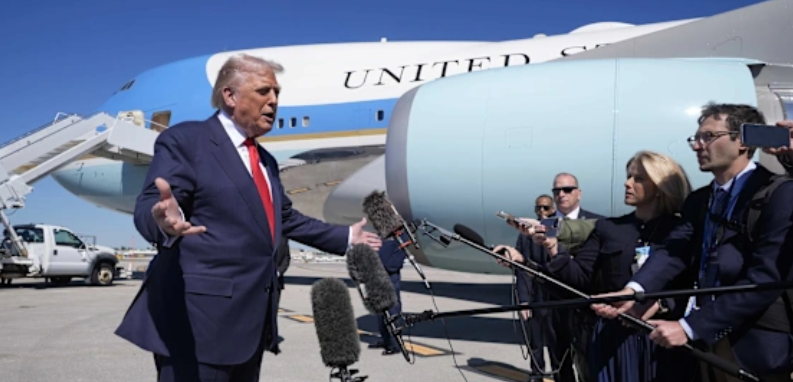
The White House on Tuesday said Americans will receive SNAP benefits, “fully complying” with a recent court order, after President Trump earlier said his administration would withhold benefits until the government shutdown ended, sparking confusion.
Speaking to reporters, press secretary Karoline Leavitt clarified Trump’s comments. “The administration is fully complying with the court order. I just spoke to the president about it,” she said. “The recipients of these SNAP benefits need to understand it’s going to take time to receive this money because the Democrats have forced the administration into a very untenable position.”
Earlier on Tuesday, Trump wrote in a social media post that SNAP benefits would not be sent out as long as the government remains shut down. The president wrote in part that the food aid benefits “will be given only when the Radical Left Democrats open up government, which they can easily do, and not before!”
Trump’s post contradicts a court filing made by his administration on Monday, saying that it would partially fund SNAP benefits for November but did not specify how much individual food stamp recipients will receive or when they might be able to access them.
The decision came in response to a pair of court rulings last week that ordered the Department of Agriculture to use billions of dollars it has in a contingency fund to cover at least some of the cost of benefits through the Supplemental Nutrition Assistance Program. Benefits for more than 40 million Americans who are enrolled in SNAP, also known as food stamps, did not go out as scheduled on Saturday because of the government shutdown.
The USDA had previously argued that it couldn’t use those funds because they were specifically designated for emergencies, such as natural disasters. The judges in two separate cases rejected the USDA’s argument on Friday and found that the department is legally obligated to use the money it has on hand to cover SNAP.
In a court filing on Monday, the USDA estimated that it has $4.65 billion remaining in its contingency fund that can go to SNAP, enough to pay for “50% of eligible households’ current allotments.” The administration considered pulling money from other programs to fully fund November SNAP benefits, specifically a program that provides free and reduced-cost lunches for schoolchildren, but ultimately determined that would pose an “unacceptable risk” to food security across the country.
When will benefits go out and how big will they be?
The funding for SNAP benefits comes entirely from the federal government, but states themselves are in charge of distributing it. That could mean that residents in some states may have to wait much longer to receive their benefits than others.
In its filing, the USDA said that some states will be able to handle the logistics of doling out the reduced benefits “in an automated manner with minimal disruption.” But other states may face “procedural difficulties” that could cause “significant delays” in getting SNAP money to the people who need it. The process of adjusting state SNAP systems could take “anywhere from a few weeks to up to several months,” the USDA said.
States will also be responsible for calculating how much each SNAP recipient will get, based on guidelines provided by the federal government. It’s unclear how much discretion each state will have in deciding how it allocates the partial SNAP funding, including whether it will have the power to provide the neediest recipients with more than half of their usual monthly allotment.
Last year, the average person enrolled in SNAP got about $187 per month, but benefits can vary greatly based on individual needs and where people live. The typical SNAP household with a child in the U.S. got $574 total each month. The average monthly benefit in Hawaii was $377, the highest in the nation and $220 more than the average benefit in Minnesota.
How we got here
SNAP is the nation’s largest food assistance program. It provides benefits to nearly 42 million Americans each month, roughly 12% of the U.S. population. The program was started in the wake of the Great Depression, but the number of people enrolled and the total cost have skyrocketed in recent decades. In 2000, SNAP sent benefits to 17 million people, at a cost of about $17 billion. Last year, the government spent more than $100 billion on SNAP.
When the government shutdown started on Oct. 1, that meant there would be no new funds to cover benefits if the standoff lasted until the end of the month. Agriculture Secretary Brooke Rollins began warning weeks ago that there were “not enough funds” to pay for the program as long as the shutdown dragged on.
As the deadline grew closer, states scrambled to find ways to prevent their residents from going hungry without the food benefits they rely on. Dozens of states provided millions of dollars to food banks, while a handful were able to find money within their budgets to at least partially cover the costs of benefits themselves.
Last week, about two dozen states filed a lawsuit hoping to compel the USDA to use its contingency fund for SNAP. That case, along with a separate case filed by a collection of nonprofit groups, ultimately forced the Trump administration to begin the process of paying out partial benefits.
Monday’s announcement may not be the last major development in the legal battle over SNAP benefits. At least one left-leaning legal group is considering whether to file further litigation in an effort to secure full benefits for SNAP recipients, according to the New York Times.
Uncertainty over SNAP won’t end for good until the government reopens. As of Monday, there were few signs that a deal to end the standoff, which will become the longest-ever on Wednesday, might be imminent.