





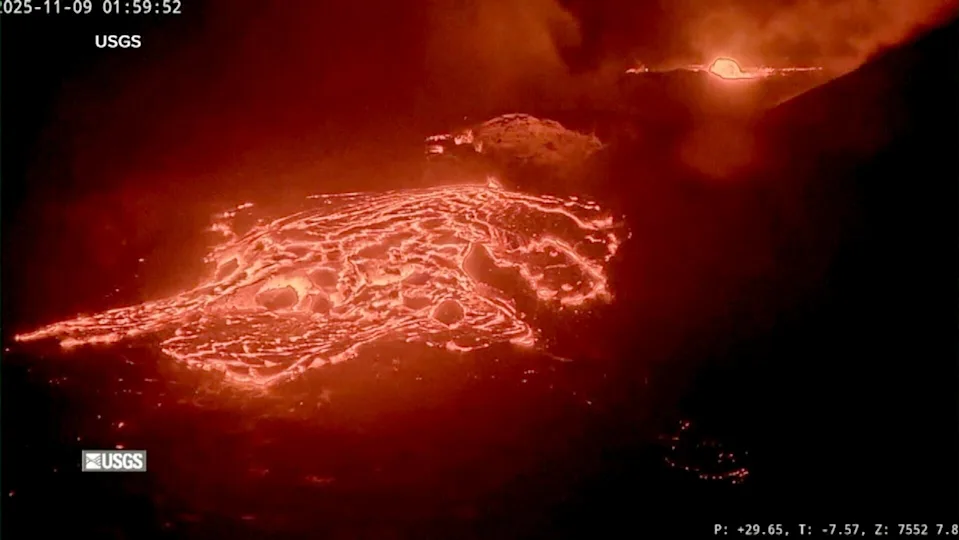
Hawaii’s Kilauea volcano is once again shooting lava more than 1,000 feet into the air.
Episode 36 of the current series of eruptions at Kilauea, located on Hawaii’s Big Island, began on Sunday morning and lasted for nearly five hours of continuous fountaining, according to the United States Geological Survey.
At some points, lava fountains reached between 1,000 and 1,100 feet, according to measurements by the Hawaiian Volcano Observatory.
The volcano spewed so much lava that flows covered up to 80% of the floor of the Halemaʻumaʻu crater, the USGS said. The eruption was contained to a closed area of Hawai’i Volcanoes National Park.

A volcano watch — or Code Orange — remains in place, indicating that an eruption is either likely or occurring, but with no or minor ash.
The current episodic eruption began on Dec. 23, 2024, and has produced significant lava fountaining not seen since the 1983–86 episodic fountains at the beginning of the Puʻuʻōʻō eruption, according to the USGS.
Episode 35 occurred on the night of Oct. 17 and ended early the next morning, during which Kilauea produced the highest single fountain seen during this eruption so far, the USGS said.
Lava fountains from the south vent reached 1,500 feet, and eruptions from the north vent reached heights of 1,100 feet during that episode, according to the USGS.

That episode produced about 13 million cubic yards of lava, with a combined average eruption rate of 500 cubic yards per second.
Most episodes of fountaining since the eruption began have continued for about a day or less — separated by pauses lasting for several days, the USGS said.
Hazards from eruptions at Kilauea include high levels of volcanic gas, ash, pumice, scoria and reticulite and Pele’s hair — strands of volcanic glass produced by lava fountaining that can be carried more than 10 miles from the vent, according to the USGS.

Various volcanic fragments have been known to fall on Highway 11, west of Hawai’i Volcanoes National Park, according to the USGS.
Other significant hazards include instability, ground cracking and rockfalls around the Kīlauea caldera .