





The White House is diving deeper into midterm mode.
Administration officials this month called in disgruntled parts of the 2024 coalition — from podcaster Joe Rogan to the Make America Health Again bloc — to make up. Three Cabinet officials have departed the administration in a two-month span, ending over a year of stability and likely giving the GOP-controlled Senate time to confirm replacements before a potential shift in the chamber. And President Donald Trump got back on the road last week for a two-day swing of base-rallying speeches in key battleground states.
Taken together, the moves — which come as chief of staff Susie Wiles convenes a series of strategy meetings, and her deputy, James Blair, takes a temporary leave to oversee the political operation from the outside — demonstrate the White House’s increasing focus on the fast-approaching midterms. The ramp-up comes as the president’s poll numbers sag and Republicans grow increasingly concerned about their midterms prospects — fears validated Tuesday night with a loss in a Virginia redistricting battle.
“What you’ve got is Susie and James [Blair], they’re doing the blocking and tackling that needs to be done to put Republicans in the best position possible,” said a person close to the White House, granted anonymity to discuss the strategy, including the effort to repair any damage with key 2024 constituencies.
“It’s trying to put the band back together. The reason why the president won all those battleground states — he put together that record coalition,” the person continued. “It’s hugely important.”
Republicans have grown increasingly concerned that the president is hurting their election-year prospects including by creating distractions with a war in Iran that threatens to overshadow economic gains and blunt their affordability message. Trump continues to promise a quick end to the war, but negotiations to resolve the conflict are again on hold.
Trump, at least temporarily, appeased some anxious Republicans last week with midterms-focused speeches out West. After a five-week essential hiatus from outside-the-Beltway speeches, he touted the party’s tax cuts and hit a slew of base-rallying topics in his Phoenix speech — from border security to crime and transgender women in women’s sports.
One GOP campaign strategist, granted anonymity to discuss planning, said there will be an uptick in these events.
“He is starting to ramp that up, and I think we’re going to see more of that,” the strategist said. “They want to see him out there. They want to see him on the trail, and in these states talking to people.”
In the speech, the day after Tax Day, Trump also touted the tax benefits in his megabill and criticized Democrats for voting against it.
“President Trump is the unequivocal leader of the Republican Party and remains laser focused on keeping the American people safe, lowering costs for working families, and making our country greater than ever before,” said White House spokesperson Taylor Rogers. “Last week, Americans across the country received historic tax refunds thanks to President Trump’s One Big Beautiful Bill.”
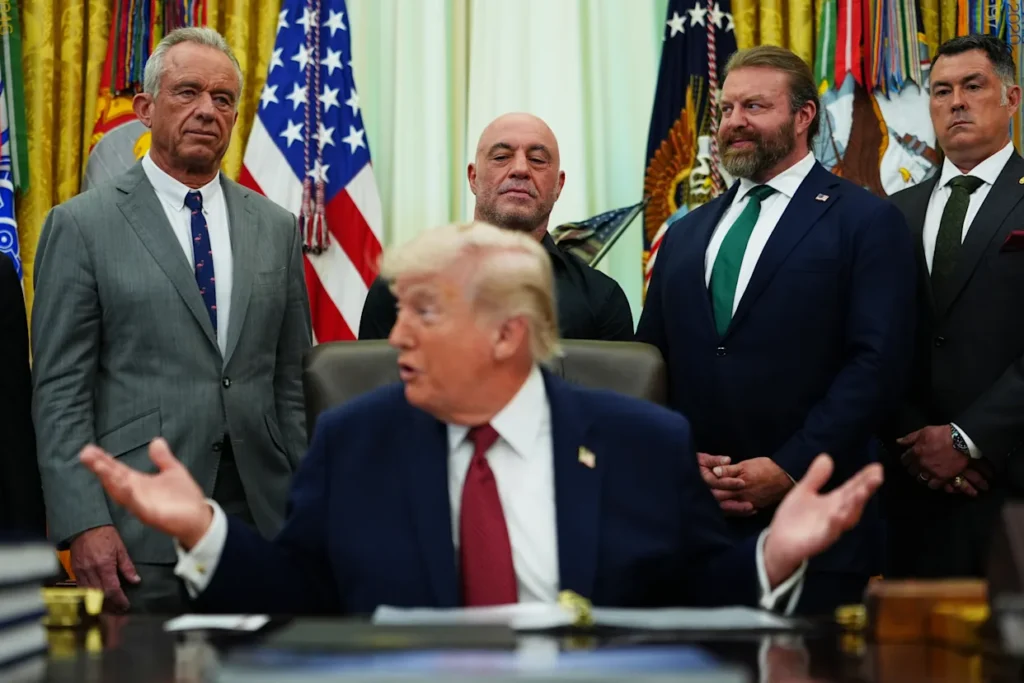
Back at the White House, the president also held a number of events this month designed to shore up support with key parts of his 2024 coalition that had begun to fray. On Saturday, Trump had Rogan in the Oval Office to roll out an executive order to review psychedelic drugs for conditions like severe depression. Rogan, who is extremely influential among young men, opposes the war with Iran, talking on his podcast to agrowing cohort of young MAGA loyalists who feel betrayed by Trump’s actions with Israel in the Middle East.
“There is a crew inside the White House that realizes that … they have to listen to the groups when the president’s popularity is down,” said a person close to the administration, granted anonymity to speak freely.
In mid-April, top White House officials including senior adviser Stephen Miller and press secretary Karoline Leavitt sat for a lengthy listening session with MAHA advocates, followed by a tour of the Oval Office from Trump. The visit, while viewed as only a start by some of the president’s MAHA supporters, was seen as a peace offering to the movement that helped elect him, after the White House handed a slew of wins to the pesticide industry that went against MAHA’s goals.
“It was very open ended, it was very conversational, and it was just, ‘Tell us what’s resonating with you. What would you like to see happen?’” Alex Clark, one of the MAHA influencers invited to the White House, told POLITICO after the meeting. “And everybody was taking notes and just really open to hearing what we had to say.”
The White House was eager to hear from the most vocal critics of the administration’s recent order boosting domestic glyphosate production in defiance of MAHA’s wishes, White House senior adviser Calley Means said Tuesday at the POLITICO Health Care Summit. He said the White House asked Health and Human Services Secretary Robert F. Kennedy Jr.’s team to compile the top 10 critics of the order.
“They invited them to the White House. We had a private meeting — two hours, no holds barred, direct conversation. And then they spent a lot of time with the president,” Means said. “Inevitably with something this high stakes, there’s going to be frustration. Inevitably there’s going to be ups and downs.”
Clark, who had been posting to her tens of thousands of followers in the lead up to the meeting about the huge losses facing the GOP in the midterms because of Trump’s actions on pesticides, said the meeting was at least a start. “They’re trying to understand,” she said.
And on Tuesday night, a recording of Trump reading a verse from the Old Testament will be released as part of a presentation at the Museum of the Bible — a week after he spurred backlash with an AI-generated depiction of himself as Jesus.
The midterms — and the risk that the Senate’s ability to confirm Trump appointments flips in Democrats’ hands — also loom large on personnel decisions. Trump has enjoyed a swift confirmation process for most Cabinet-level appointees and Republicans have about six more months to leverage a majority to confirm replacements, including for recent vacancies at the Justice and Labor departments.
Scandal-ridden Labor Secretary Lori Chavez-DeRemerstepped down Monday, amid a series of misconduct allegations against her and her top staffers. Her departure follows former Homeland Security Secretary Kristi Noem, who was replaced by Senate-confirmed Secretary Markwayne Mullin, and former attorney general Pam Bondi, who has been replaced with acting director Todd Blanche.
“The timing is important on these changes because the margin in the Senate matters and with the midterms the White House knows it’s better to make changes now where we know we can confirm folks instead of taking the risk later,” said a second person close to the White House.