






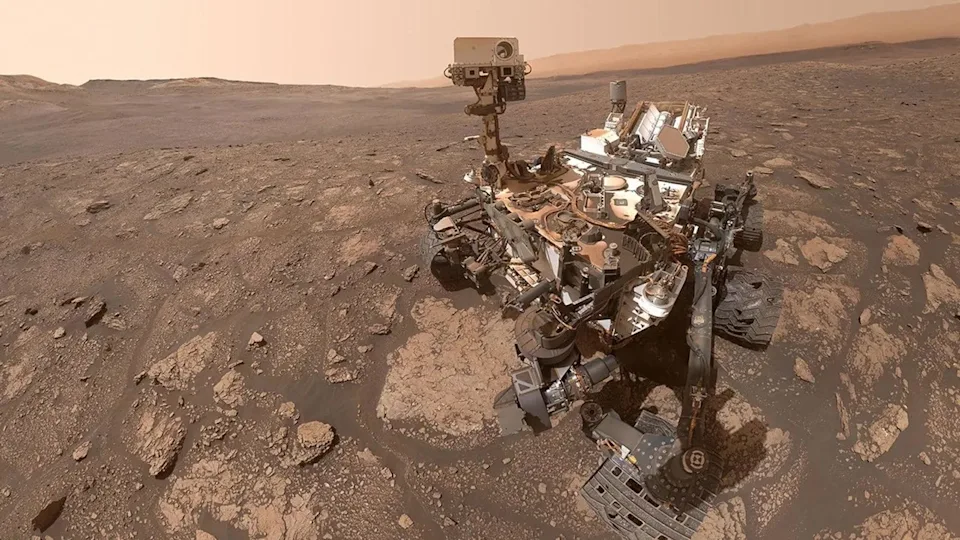
Finding life on Mars might be closer than we once thought: NASA’s Curiosity rover has yielded promising data from the Red Planet.
According to a news release from NASA April 21, scientists confirmed the presence of essential ingredients of life preserved in 3.5-billion-year-old Martian sandstone.
NASA said the rover collected clay-filled rocks from an area called Glen Torridon inside the planet’s Gale Crater. The rover’s Sample Analysis at Mars (SAM) mobile instrument suite then analyzed the data.
“That detection is pretty profound because these structures can be chemical precursors to more complex nitrogen-bearing molecules,” Amy Williams, the paper’s lead author, said in the news release.

Officials said the molecules were identified using a first-of-its-kind “wet” chemistry experiment, which uses the chemical tetramethylammonium hydroxide (TMAH). According to NASA, the chemical allows the rover to break down “larger molecules that would be difficult to detect and identify otherwise.”
Once the samples were broken down, the rover was able to reveal the presence of more than 20 organic molecules. Among the molecules detected were naphthalene and benzothiophene, some of the most complex organic compounds ever discovered on the Martian surface, NASA said.

One step at a time
The most recent discovery is only the latest sign pointing to possible life in Mars’ past. In a study published in February, NASA said rock samples collected in 2025 showed organic compounds that on Earth are most often produced by living things.
The compounds, the largest ever found on Mars, were believed to be fragments of fatty acids preserved in ancient mudstone in the Gale Crater, NASA said. On Earth, fatty acids are a key indicator of life, because they are most often produced by living organisms.


What is NASA’s Curiosity rover?
Curiosity is one of NASA’s two car-sized robots − the other is Perseverance − exploring the Martian surface for signs that the planet was once habitable.
Scientists believe the geology of Mars may hold valuable clues about the possibility of ancient life. The robotic vehicles, controlled remotely from Earth, have slowly navigated the rocky terrain to collect intriguing samples.
Curiosity began its voyage to Mars in November 2011 and landed in August 2012 in the Gale Crater on the boundary between Mars’ cratered southern highlands and its smooth northern plains. While exploring the crater, believed to have formed 3.7 billion years ago, Curiosity has collected 42 rock samples crushed into powder with the drill on the end of its robotic arm.
Contributing: Eric Lagatta
Fernando Cervantes Jr. is a trending news reporter for USA TODAY. Reach him at fernando.cervantes@usatodayco.com and follow him on X @fern_cerv_.
This article originally appeared on USA TODAY: NASA’s Curiosity finds never before seen organic molecules on Mars