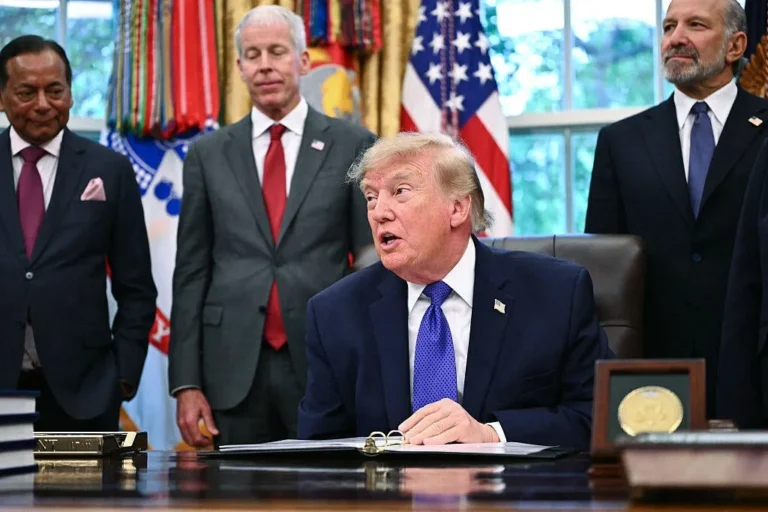






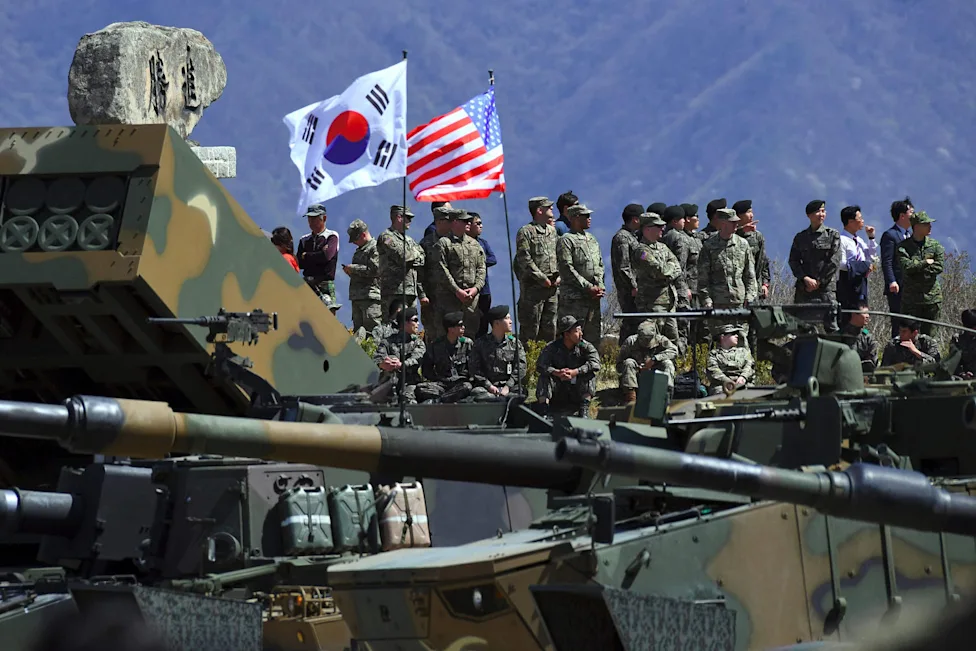
President Donald Trump said Sunday that he has directed the Defense Department to scale down joint military exercises with South Korea, citing the U.S. ally’s refusal to join the war in Iran and his “very good” relationship with North Korea’s Kim Jong Un.
Trump said the large, annual military drills sent a “signal that is totally inappropriate and hostile” to North Korea, a nuclear-armed state with which the U.S. has no formal diplomatic ties but which Trump says has been “unthreatening and respectful” as long as he has been president.
“Based on the fact that it is too late to cancel, I have instructed Secretary of War, Pete Hegseth, to substantially reduce the Joint Military Exercises!” Trump wrote on social media. His announcement came just hours before the drills were set to start.
Trump also mentioned South Korea’s refusal to join the Iran war.
“While somewhat unrelated (?), I recently asked the President of South Korea if they would like to join us in the Denuclearization of the Islamic Republic of Iran, and they said, ‘No thanks!'” Trump wrote.
It was not immediately clear what a scaled-down version of the training would look like. The South Korean defense ministry said Monday that the drills, known as Ulchi Freedom Shield and scheduled to last until Aug. 27, were “proceeding as planned.”
In a statement on Monday, the office of South Korean President Lee Jae Myung said the U.S. and South Korea had “maintained close coordination” on joint exercises and training and would continue to do so.
Like Trump, Lee has expressed support for the resumption of talks with North Korea, which remains technically at war with South Korea after the Korean War ended in 1953 with an armistice rather than a peace treaty.
The government “hopes that the friendly relationship between the leaders of the United States and North Korea will lead to meaningful U.S.-North Korea dialogue, thereby opening discussions aimed at advancing peace and stability on the Korean Peninsula,” Lee’s office said. “To this end, the government will make the necessary diplomatic efforts as a ‘pace-setter,’ in close coordination with the United States.”
Lee’s office said the South Korean government had “actively participated” in international talks aimed at reaching a ceasefire in Iran and restoring freedom of navigation in the Strait of Hormuz and that it was also in close consultation with the U.S. “regarding practical and military contributions.”
According to U.S. Forces Korea, the military exercises are meant to build understanding among several agencies to ensure “their ability to fortify the combined defense posture and enhance Alliance response capabilities against a spectrum of security threats.” North Korea routinely criticizes the annual drills as a “war rehearsal,” which the U.S. and its allies deny, and threatens to retaliate.
South Korea’s embassy in Washington and U.S. Forces Korea did not immediately respond to requests for comment.
Trump’s call to curtail the exercises was criticized by lawmakers such as Sen. Mark Kelly, D-Ariz., who said they help the U.S. better defend South Korea against the North.
“Hollowing out these joint exercises is shortsighted and a mistake,” he said in a post on X.
The exercises “are essential for military forces to be ready and capable of doing their jobs,” said Leif-Eric Easley, professor of international studies at Ewha Womans University in Seoul.
“Scaling them back can damage alliance coordination, slow the process of South Korea taking on greater responsibility for its own defense, and weaken deterrence against possible conflicts in Asia,” he said in emailed comments.
It is also unlikely to win Trump a meeting with Kim, who has shown no interest in resuming talks after their earlier diplomatic efforts collapsed in 2019. Since then, Kim has advanced his nuclear and missile programs and built ties with Russia by providing troops and weapons for its war on Ukraine.
“Trump’s recent social media posts about Kim Jong Un suggest a willingness to re-engage, but North Korea is busy profiting from Russia’s war against Ukraine while modernizing its own military,” Easley said.
Trump’s announcement comes days after North Korea launched a ballistic missile toward the sea, conducting weapons testing in possible protest of the upcoming U.S.-South Korea military drills.
It also comes a day after the U.S. pulled its last aircraft carrier in Asia, as the USS George Washington was sent to replace the USS Abraham Lincoln — which has drawn scrutiny over conditions on board — in the Persian Gulf.
This article was originally published on NBCNews.com